
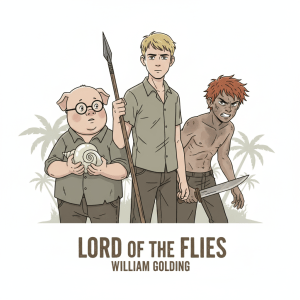
If there’s one book every IB Diploma student should read, regardless of their subject choices, it’s William Golding’s Lord of the Flies. More than just a adventurous and dark story of stranded schoolboys, this masterpiece is a study of the human experience, a thicket of ideas that dips into almost every DP subject. It’s not just a rippingly good story; it’s an intellectual Swiss Army knife, preparing minds for the interdisciplinary rigour of the Diploma Programme.
For the aspiring geographer, the very setting of the novel is a masterclass in physical and human geography. The isolated, tropical island isn’t just a backdrop; it’s an active character. Its resources (or lack thereof), topography, and climate dictate survival, movement, and conflict. Could the same story, the same behaviour and conflict have developed on a different island? Students can explore concepts like resource scarcity, the impact of environment on social structures, and the psychological effects of isolation; all within Golding’s vivid descriptions.
Economics and Business Management students will find a primitive laboratory of human enterprise. The boys grapple with scarcity (food, shelter, tools), and so they discover opportunity cost. The struggle to establish a functional society provides rich discussions of Maslow’s Hierarchy of Needs: the initial focus on physiological needs (food, water, shelter) quickly gives way to safety, and then the desperate, often violent, attempts to achieve belonging and esteem. Ralph’s attempts at democratic leadership and Jack’s authoritarian rise are interesting case studies for organizational structures and power dynamics.
Naturally, for Literature students, Lord of the Flies is a gem. Golding’s use of symbolism (the conch, Piggy’s glasses, the fire, the ‘beast’), motifs (the loss of innocence, savagery vs. civilisation), and metaphor offers endless avenues for critical analysis. The allegorical nature of the novel, exploring fundamental human nature, ensures its enduring relevance.
Historians can contextualise the novel within the anxieties of its time because it was written in the shadow of World War II and the emerging Cold War, Golding’s exploration of human savagery resonates deeply with the atrocities witnessed in the mid-20th century. It encourages discussions on the fragility of civilisation, the origins of conflict, and the psychological underpinnings of collective violence; all themes important to understanding 20th-century history.
Perhaps most profoundly, Lord of the Flies is a psychological thriller. It illustrates concepts central to Psychology, particularly Social Identity Theory. The rapid formation of in-groups (Ralph’s civilised faction) and out-groups (Jack’s hunters), the demonisation of the ‘other’ (Piggy, Simon, the beast), and the descent into deindividuation and mob mentality are powerfully depicted. It’s a clear demonstration of how situational factors can override individual morality.
And for the heart of the IB Diploma, Theory of Knowledge (TOK), the novel forces students to confront profound questions of ethics: What is good? Where do moral codes come from? Are humans inherently evil or corrupted by society? The boys’ struggle for survival, their creation of rules, and their eventual abandonment of them provide a living, breathing case study for ethical dilemmas, the nature of knowledge, and the limits of reason.
Language B students can dissect the boys’ evolving communication patterns or identify cultural references and idioms. An Extended Essay student could explore the novel’s philosophical implications, its historical context, a psychological analysis of its characters, or even a comparative study with other dystopian literature.
But perhaps the most compelling argument for making Lord of the Flies mandatory reading for every DP student is because of its connections to the Learner Profile. Every one of the attributes: Inquirer, Knowledgeable, Thinker, Communicator, Principled, Open-minded, Caring, Risk-taker, Balanced, Reflective, can be directly applied to the characters and their actions or inactions. A simple yet powerful classroom activity emerges: how might the tragic outcome on the island have been different if all the boys had been stronger examples of these Learner Profile attributes? If more of them had been principled, caring, and open-minded, rather than succumbing to fear and savagery, could they have forged a sustainable society?
Lord of the Flies is a compelling, thought-provoking narrative that inherently fosters critical thinking, encourages interdisciplinary connections, and prepares students for the complex, interconnected challenges of the real world. These are the qualities the IB Diploma aims to cultivate. It’s an unignorable island, demanding exploration from many academic angles.
 I think, therefore IB
Leave a comment