
After watching a documentary on the 2004 disaster, a tourist cancels their trip to Phuket out of fear of a tsunami despite the statistical rarity of a tsunami. Their brain is hijacked by the availability bias, mistaking the vividness of the documentary for a high probability of another tsunami.
Ironically, they choose to spend their holiday driving across the United States instead. The risk of dying in a motor vehicle accident in the US is much greater than being killed in a localised natural disaster. This demonstrates how intuition prioritises memorable drama over mundane but more lethal statistics.
Imagine a shopper walking into a luxury clothing store and seeing a designer jacket marked at $2,000. They would never pay that much, but this initial number becomes a mental ‘anchor’ that skews their perception of value for everything else they see in the store.

When the customer finds a high-quality leather coat for $800, it seems like a bargain by comparison, even if they had planned to spend only $400. This happens because the person uses the first piece of information (that $2,000 anchor) as a reference point to judge all subsequent prices against. Despite the $800 coat being expensive, the anchoring bias makes the customer feel they are ‘saving’ $1,200 rather than ‘spending’ $800.
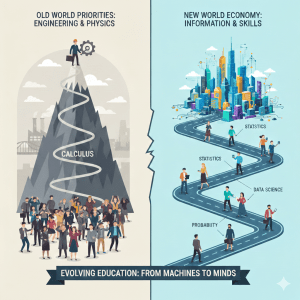
Mathematics courses all over the world share a common trajectory: counting leads to arithmetic, which leads to algebra, which leads to geometry and trigonometry, which leads to calculus – the pinnacle of high school mathematical achievement. But this path serves an elite minority, and it fails the majority. A fundamental restructuring toward statistics and probability would equip the masses for real-world decision-making.
Most adults never use calculus; derivatives and integrals are abstract concepts that have no use in most people’s lives. Statistical reasoning, though, pervades modern living. We encounter risk assessment in health decisions, interpret polling data in elections, evaluate claims in advertising, and navigate financial choices involving uncertainty in the supermarket, the car dealership and the real estate agent’s office. Despite this, most people lack the statistical literacy to engage accurately with these situations.
Daniel Kahneman and Amos Tversky’s research in the 1970s showed the depth of most people’s poor decision-making. Their studies of cognitive biases showed that people systematically err when reasoning. The availability heuristic leads us to overestimate risks based on memorable events such as heavily reported shark attacks or plane crashes rather than actual frequencies of these events. The anchoring bias leads us to rely too heavily on the first piece of information we encounter, such as advertised house price, which skews our perception of all subsequent information, such as our own perceived value of a house. The framing effect reveals that our decisions can be completely reversed depending on whether options are presented as potential gains or losses; for example, people are much more likely to choose a medical treatment described as having a 90% success rate than one described as having a 10% mortality rate, even though the probabilities are identical.
Current maths courses include very simple statistics: mean, median, mode, and perhaps basic probability. Students rarely encounter sampling distributions, hypothesis testing, confidence intervals, or Bayesian reasoning which are the very the tools needed to avoid biases. Calculus requires a lot of preparatory groundwork, but even intermediate-level statistics builds naturally from basic numeracy.
Statistical literacy enables critical evaluation of medical studies rather than blind acceptance of health claims. Understanding even simple statistics allows voters to interpret economic information and political polls. It helps consumers understand financial products, from insurance policies to mortgages to investments. In a world saturated with misleading, statistical skills are an essential civic competence.
Critics might argue that calculus develops abstract reasoning skills valuable beyond its direct applications, but statistical thinking offers equally rigorous intellectual development while maintaining a deeply practical relevance. Grappling with uncertainty, understanding variability, and distinguishing correlation from causation demand sophisticated analytical thinking. And statistics connects naturally to other disciplines such as psychology, economics, biology, geography…, making mathematics feel applicable and relevant rather than isolated and irrelevant.
The traditional calculus pathway reflects old world priorities when engineering and physics dominated higher education. Today’s knowledge and information economy demands different skills.
A reformed curriculum might teach numeracy and descriptive statistics early, progress to probability theory and inferential statistics in middle years. Calculus can remain as an optional specialization for those pursuing specific technical fields. This inversion would serve the many rather than the few, equipping citizens with tools to navigate uncertainty, evaluate evidence, and make reasoned decisions in a complex world. Kahneman and Tversky showed us how and why we fail. Statistics and probability can change that.
 I think, therefore IB
Leave a comment